PC-Seg: Progressive Cross-View Consistency for 3D OCT Segmentation from Sparse 2D Annotations
Tsubasa Konno (Tohoku University), Takahiro Ninomiya (Tohoku University), Yukun Zhou (University College London), Koichi Ito (Tohoku University), Siegfried Karl Wagner (University College London), Yiqun Lin (University College London), Pearse Andrew Keane (University College London), Toru Nakazawa (Tohoku University), Takafumi Aoki (Tohoku University)
International Conference on Medical Image Computing and Computer Assisted Intervention, pp. 371--382, September 2026.
Abstract
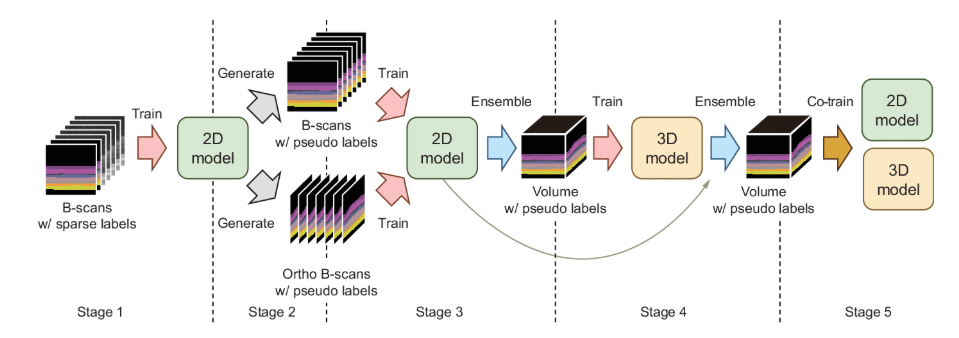
Volumetric segmentation of Optical Coherence Tomography (OCT) images is essential for diagnosing ocular diseases but requires labor-intensive voxel-wise annotations. While semi-supervised learning (SSL) can reduce annotation costs, most existing methods process data slice-by-slice, failing to exploit the inherent 3D spatial context. In this paper, we propose PC-Seg (Progressive Cross-view Segmentation), a novel curriculum learning framework that lifts sparse 2D annotations to high-precision 3D segmentation models. Unlike conventional multi-view approaches, our method employs a single 2D model to learn cross-view consistency from both standard B-scans and orthogonal slices, generating reliable volumetric pseudo-labels. These labels are then distilled into a 3D model, followed by a co-training phase where 2D and 3D models mutually refine each other through ensemble pseudo-labeling. Experiments on the MSHC dataset and the Duke DME dataset demonstrate that our method achieves accuracy comparable to fully supervised learning using only about 0.7\% of the labeled data, outperforming both state-of-the-art semi-supervised and retinal layer segmentation methods. Our code is publicly available at https://github.com/gsisaoki/pc-seg-official.